Egoi Martinez took the mountains jersey today, with Franco Pellizotti 23 points behind. I expected David Moncoutie to make a stronger run for the jersey, but he did enough too keep himself in contention by getting in today's early break and fighting for a few points. Yes, this is a minor matter, but I don't have much more to say about the fairly boring stage today. Whatever happened to that plucky little mountain scamp, Riccardo Ricco? I miss him.
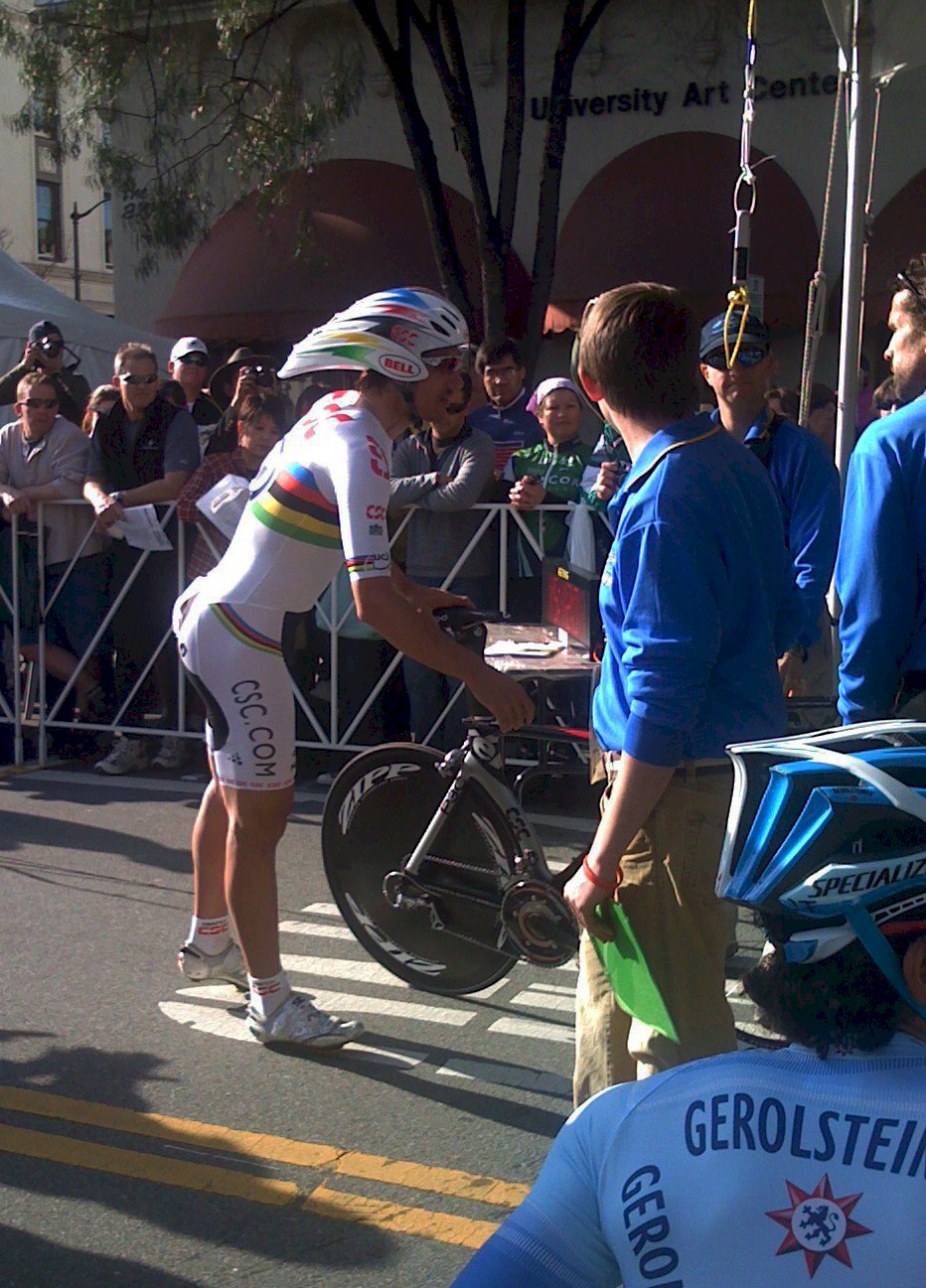
I also missed most of the TV coverage since I was "enjoying" a 40km time trial today. Unfortunately I did just well enough to encourage myself to put some more work into TTs. My current muscle aches provide evidence that Fabian Cancellara's massive glutes have contributed greatly to his success.
Sunday, July 12, 2009
Saturday, July 11, 2009
TdF Stage 8
I do love a small group sprint, and today Luis Leon Sanchez made it look easy. He waited form Casar to do most of the work to bring Efimkin back, closed the gap himself with a few pedal strokes, then paused and let Casar come around to lead him out. He glanced over his right shoulder as if he was giving Casar permission to go, then came around him easily for the win.
I hung around to watch the Versus interviews this morning. They really need to give George Hincapie a while to recover before doing post-stage interviews. Let him have something to drink, maybe some food to get some glucose back in his brain. Ambushing him while non-functional just isn't fair. Then Thor Hushovd had trouble getting his massive Viking hands through the tiny bike-racer sleeves on that green jersey.
Johan Bruyneel claims confusion at the early attack from Cadel Evans. Don't play coy with us, you Belgian minx! Everyone knows you are the evil genius of le Tour, the puppetmaster who controls all.
Oscar Pereiro apparently gave up today. Is his career Beloking?
I hung around to watch the Versus interviews this morning. They really need to give George Hincapie a while to recover before doing post-stage interviews. Let him have something to drink, maybe some food to get some glucose back in his brain. Ambushing him while non-functional just isn't fair. Then Thor Hushovd had trouble getting his massive Viking hands through the tiny bike-racer sleeves on that green jersey.
Johan Bruyneel claims confusion at the early attack from Cadel Evans. Don't play coy with us, you Belgian minx! Everyone knows you are the evil genius of le Tour, the puppetmaster who controls all.
Oscar Pereiro apparently gave up today. Is his career Beloking?
Friday, July 10, 2009
TdF Stage 7
Fantastic win by Brice Feillu as France takes first and second on a mountaintop finish. Cue the "Is this what a clean Tour looks like?" speculation. It's another great result for France and a big day for Feillu's title sponsor, le ribcage.
In GC news, so concludes the Great Astana Leadership Drama of 2009. Contador now leads Armstrong and I doubt that is going to change. Armstrong should race for second, donate millions to the UCI anti-doping program, and maybe have a longshot chance for an eight Tour win as we head into fall. Leipheimer looked more comfortable than I expected, and Evans continues to loosen up his style nicely. Andy Schleck was disappointing; I expected him to follow Contador but he couldn't even drop his fat brother. And how about track star Bradley Wiggins climbing with the GC contenders and attacking in the final kilometer? Suspicalicious!
In GC news, so concludes the Great Astana Leadership Drama of 2009. Contador now leads Armstrong and I doubt that is going to change. Armstrong should race for second, donate millions to the UCI anti-doping program, and maybe have a longshot chance for an eight Tour win as we head into fall. Leipheimer looked more comfortable than I expected, and Evans continues to loosen up his style nicely. Andy Schleck was disappointing; I expected him to follow Contador but he couldn't even drop his fat brother. And how about track star Bradley Wiggins climbing with the GC contenders and attacking in the final kilometer? Suspicalicious!
Thursday, July 9, 2009
TdF Stage 6
Over 20 riders crashed in today's stage. That looked far more dangerous than the TTT; I wonder who will be the first rider to call for canceling races when it rains. Angry about being left out, René Haselbacher crashed at the Tour of Austria.
The UCI sorta promises next-day turnover for doping results. This could be a problem, since it doesn't allow much time to leak the positives to L'Equipe.
Tomorrow ends with a bit of switchbacky goodness:
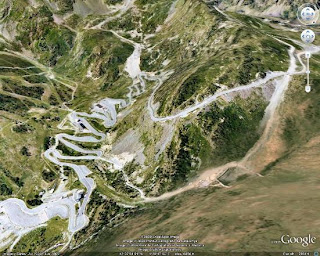
Hard for me to see anyone other than Contador winning.
The UCI sorta promises next-day turnover for doping results. This could be a problem, since it doesn't allow much time to leak the positives to L'Equipe.
Tomorrow ends with a bit of switchbacky goodness:

Hard for me to see anyone other than Contador winning.
Wednesday, July 8, 2009
TdF Stage 5
Well done, Mr Voeckler! I wonder how many other people didn't know he had never won a TdF stage. Maybe he was given an honorary win at some point.
I agree with whiny Rolf Aldag. If you're sending a team to the Tour, it only makes sense to try winning a stage.
And finally, Bradley Wiggins is saying:
I agree with whiny Rolf Aldag. If you're sending a team to the Tour, it only makes sense to try winning a stage.
And finally, Bradley Wiggins is saying:
[T]here are so many different levels at this Tour: there are 100 blokes who are good and 100 blokes who are not so good, and it's all mixed up.Is he saying it's a peloton at two speeds, and he's in the fast group? My goodness, that team is suspicious.
TdF Stage 4
In general, team time trials are only slightly less boring to watch than individual time trials (unless Rasmussen is involved). But this was pretty interesting. Two points:
- I think bike handling is a respectable skill and should be rewarded. I was happy to see Paris-Roubaix decided by bike handling and I don't mind it being part of the Tour.
- Garmin had four guys working for the majority of the race, compared to almost twice that many for most teams. And yet they beat almost everyone, finishing second by only 18 seconds. That's an amazing effort. One might even say superhuman!
Lance Armstrong
It is currently my intention that this is going to be a cycling blog, mostly related to pro cycling. I think it is customary to first address every cycling fan's primary question: what do I think about Lance Armstrong? Why, thanks for asking.
I don't particularly like or dislike Lance Armstrong. I have been following cycling closely since 2000, when I started racing with some friends. The crowd I rode with were somewhat ambivalent about Armstrong. They appreciated his Tour successes but as members of a somewhat snobbish niche community they tended to maintain their loyalties to the European stars who were unknown in the United States (Pantani, Jalabert, etc). My personal favorites have been attackers who make races exciting, like Jens Voigt and Ludo Dierckxsens. Armstrong's Tour years were long stretches of predictability punctuated by the occasional fireworks. So I guess he's ok.
I've never been especially bothered by pros who dope. I'm amused to see cheaters get caught, but I've never seen any reason to get angry about something as inconsequential as a pro bike race. However, since I work in biotech and race on the weekends, I am interested in what's behind pro performances. I'm particularly curious about the balance between genetic and therapeutic contributions to a racer's success and, in this respect, there is no greater curiosity than Mr Lance Armstrong.
Armstrong's Personality
Before I get into the doping issues, let me state that everything I've read and seen about Lance Armstrong suggests he is a jerk. He's an ass to his competition and a prick to anyone who criticizes him. But he's a hell of a bike racer. The quintessential Armstrong race was the famous "no gifts" Stage 17 of the 2004 Tour de France into Le Grand Bornand. He used his highly paid (and probably doped) teammates to fragment the field and chase down the struggling break. He offered a half-assed effort to help a teammate win the stage, but when that looked unlikely he unleashed a perfectly-timed, ferocious sprint to chase down and beat Andreas Kloeden, an accomplished rider who had never won a Tour stage. It was an incredible performance, and one motivated by his desire to punish German fans for their crude behavior against him the previous day (Kloeden was riding in the German national champion's jersey). Armstrong's tender sensibilities were further exhibited in a post-race interview, when he explained that he had "given gifts in the Tour de France and very rarely has it ever come back to help [him]." This prickly egoism can be hard to take from a guy who is dominating the Tour for the sixth time. But that was one of the most exciting finishes I've ever seen, so at the end of the day I don't really mind Armstrong's comments or his motivation. It was a great bike race.
Many contrarian types also criticize Armstrong for his personal life and his LiveStrong organization, but I'm not interested in Armstrong's personality or hero status here. He's just a guy who rides a bike fast.
Armstrong's Genetics
It has been said that Armstrong’s physiology is maybe above average for an athlete but nothing beyond past Tour champions. According to the blood test values he has recently released, his level of success wasn’t due to a naturally astronomical hematocrit that let him race above 50%. Neither was it his V02 max, which reportedly peaked around 82-84 ml/kg/min – elite but below Indurain and Lemond’s values of 88 and 92.5 ml/kg/min, respectively. The one extraordinary number that constantly appears in discussions of Armstrong’s physiology is his low lactic acid production. It has been reported that during anaerobic efforts his lactic acid production is one-third to one-half the normal rate. Since lactic acid is thought to cause muscle pain and fatigue during intense efforts, it is often stated that Armstrong’s advantage is that he does not feel the pain that others do and he can therefore push harder. That sounds reasonable, but I wonder if there is more to it than that. Lactic acid is not primarily a fatigue-signaling molecule; it is an irritating waste product of fermentation and accumulates during anaerobic conditions. So if Armstrong’s muscles either do not producing lactic acid at a normal rate or somehow remove lactic acid during anaerobic efforts, his metabolism must be abnormal. So Lance Armstrong might have a genetic metabolic disorder that allows his muscles to strangely create lots of energy around lactate threshold. This is pure speculation -- the type of speculation that a geneticist engages in when considering a seven-time Tour winner, because a geneticist is fascinated by freaks of nature.
Armstrong's Therapeutics
There have literally been books written about whether Lance Armstrong doped his way to seven Tour victories. Since there is plenty of evidence that his competition doped, a common Armstrong defense is that the playing field was level. That is a reasonable position if you're willing to concede that he doped, but just makes the question all the more fascinating to me: was Armstrong clean when he beat them?
David Walsh certainly doesn't think so. He has made a career of making doping allegations against Armstrong. He has a mountain of circumstantial evidence but has never produced anything I find conclusive. While I'm convinced that there was doping on US Postal, most of the strong evidence I've read addresses the pre-Armstrong years or Armstrong's teammates.
There is some evidence that Armstrong used synthetic EPO based on his hematocrit readings. According to a Bicycling article about Dr Michele Ferrari, Armstrong was recorded to have a maximum hematocrit of 47%. It's not clear to me when these values were taken; it might have been prior to Armstrong's cancer. Recently released data on Armstrong's current (2009) blood values show a maximum hematocrit of 43%. I don't know if this sort of variation can be achieved without doping, but it does suggest that Armstrong rode with a higher than natural hematocrit. However, to Armstrong's credit, the same article mentions that US Postal teammate and fellow Ferrari client Kevin Livingston's hematocrit was 49.9%, just below the UCI limit of 50%. If Ferrari was also doping Armstrong, why would he max out at 47%?
The real proof of Armstrong's doping would be a failed drug test, but unfortunately the major positive result is mired in uncertainty. In 2005, synthetic EPO was found in at least six of Armstrong's blood samples from the 1999 Tour. This finding was described in detail in an interview with Dr Michael Ashenden on Velocity Nation. A group of researchers was trying to develop detection methods for synthetic EPO in athlete's urine. They needed a training set for the tests; that is, a group of blood samples in which some were known to have synthetic EPO. They chose Tour de France samples from 1999. It isn't clear to me why they didn't use medical samples from anemia patients who had definitely been treated with synthetic EPO. Instead they made the assumption that there must have been doping during the 1999 Tour and thus there would be positives. From a scientific standpoint, this is a very questionable study design. A positive control should, by definition, consist of fully specified and characterized samples, not mysterious samples paired with the assumption of guilty athletes. It is obvious that if you are tuning your test until you recover a positive result (which is what you do with a positive control) you will get a positive result. Without a proper positive control, there really isn't any way to determine if the test was properly tuned. This makes the study findings very difficult to interpret. However, one might argue that if the analysis was producing random noise, it is very unlikely that so many of Armstrong's samples (6 out of 15) would test positive. This compares to 13 positives in a total of 87 samples, and according to my math the likelihood that Armstrong would have so many positives in random data is 1 in 120. So even if the study was poorly designed, over a third of Armstrong's samples were positive whereas only 10% of the other samples were. That is a pretty powerful argument and I'm almost convinced. However, Ashenden then overplays his hand by claiming that the only possibilities are that Armstrong doped or the samples were deliberately tainted by laboratory personnel. But this just begs the question of having a controlled experiment; Ashenden shouldn't rule out other possibilities because the researchers weren't controlling for other, possibly unknown, variables that might be correlated with Armstrong's samples. So while these arguments support the hypothesis that Armstrong doped in the 1999 Tour, I don't think this hypothesis has been validated to scientific or legal standards.
As a minor point, Ashenden claims it was impossible for the labs to know whose samples they were testing. Given the UCI and French anti-doping lab's long history of leaking doping positives to L'Equipe, I am not convinced that the information barriers Ashenden claims exist between these entities are always respected. So I do not share his complete trust in the competence and ethics of these labs.
Nevertheless, the study is the best Armstrong-related doping evidence and Ashenden deserves credit for taking the effort to explain it. Unfortunately Ashenden and his interviewer Andy Shen don't stop there. Shen bizarrely asserts that Armstrong is far shorter than advertised, and stands only 5'5" or 5'6" tall. Ashenden later claims Armstrong weighed over 74 kg (163 lbs) when he was winning the Tour. This data corresponds to a BMI of at least 26. This is officially considered "overweight" by the NIH. I understand the NIH standards apply poorly to muscular builds, but pro bike racers are built like the skeletons of ballerinas. I am 6'1" and 158 lbs (BMI 21) and look like a gluttonous hulk when standing next to one of our local pros. So I am supposed to believe that Lance Armstrong won the world's hardest bike race with a BMI of 26, and furthermore that this means I should question Armstrong's credibility? This is not terribly convincing. In fact, it is extremely weird.
Speculation on Armstrong's weight is primarily introduced to make the case that his post-cancer transformation into a grand tour champion was a result of doping. This is speculative ground, but relevant in light of a common counter-argument based on a study by Ed Coyle. The Coyle study claimed novel physiological changes brought about by Armstrong's specialized training enabled him to transition from a single-day racer to a grand tour winner. I think Ashenden convincingly refutes most of this study, allowing the possibility for other theories. Ashenden's personal theory is that Armstrong doped. It essentially comes down to the contention that Armstrong lied about his weight (of course he did; every professional athlete lies about their weight). Ashenden is particularly keen to show that Armstrong's post-cancer weight loss was a lie (and an illusion for those of us who have seen pre- and post-cancer video footage). He tries to refute Armstrong's claim that he weighted 72 kg during his Tour wins by quoting Coyle's measurement of 79 kilograms for Armstrong's weight in November 1999. According to Ashenden, Armstrong wouldn't allow himself to gain so much weight between races, so clearly Armstrong was not as low as 72 kg during the Tour in July. This is neither a evidence-based nor convincing assertion. November is the heart of the off-season for a cyclist who concentrates on July, and it is not unheard of for pro (and amateur) cyclists to gain significant weight during the fall and burn it off during daily 5-hour training rides in the winter and spring. Ashenden then asserts that because Armstrong admitted under oath to a race weight of 74 kg, he really must have weighed more than that. There is no evidence to support this hunch. I think the best one can say here is that we don't know how much Armstrong actually weighed, at any time during his career. Which means one can't draw any conclusions about how big a role weight loss played in Armstrong's Tour success.
Ashenden also uses Tour de France time trial results to measure Armstrong's pre and post cancer performance gains. I think it is common knowledge that riders without an interest in the overall classification of a grand tour often do not put a full effort into the time trial stages. These riders lose hours over the mountains stages; losing ten more minutes in the time trials is nothing if one can save their energy for a chance at a stage win down the road. Before cancer Armstrong was riding for stage wins and after cancer he was riding for the overall, so judging his differences in fitness by time trials is inconclusive and kind of silly.
Finally, my greatest objection to the argument that doping transformed Armstrong into a Tour winner is that it implies pre-cancer Armstrong was a clean, or at least cleaner, racer (otherwise he would have won the Tour earlier). Personally I think this is highly dubious. Armstrong was the number one ranked cyclist in the world at age 21, in an era famous for rampant doping in pro cycling. He won the prestigious World Championships Road Race by riding away from a peloton of the world's best dopers to cross the line alone. Frankly, I would be shocked to learn Armstrong wasn't doping at that time. If Lance Armstrong was clean in 1993 then his cycling gifts are truly awesome, and I have no problem believing every one of his Tour wins were the product of a new post-cancer focus with no drugs involved. Alternatively, if he was doping prior to cancer, drugs alone won't explain the later Tour success. One could split hairs and make the argument that he was doping back then, but after cancer his doping practices were re-focused on the Tour and greatly intensified. Sure, maybe. But I don't see how you can make this argument with numbers, as per Ashenden; you are left with comparing one set of performance metrics clouded by the effects of doping with another set of performance metrics clouded by doping. One can only isolate the effects of doping by comparing a non-doped Armstrong with a doped Armstrong, and I'm not convinced anyone has this data.
So did he or didn't he?
If I had to make a call, I would ignorantly guess that Armstrong doped during his Tour victories. I'm still fascinated by the idea that he harbors a very rare and advantageous genetic makeup, but that just seems less probable. The best I can hope for is that he is able to contend for overall victory at this year's Tour and he continues to release his blood values while he does it. If he can win the Tour at age 37 with a hematocrit of 43%, he might just be the freak he claims he is.
I don't particularly like or dislike Lance Armstrong. I have been following cycling closely since 2000, when I started racing with some friends. The crowd I rode with were somewhat ambivalent about Armstrong. They appreciated his Tour successes but as members of a somewhat snobbish niche community they tended to maintain their loyalties to the European stars who were unknown in the United States (Pantani, Jalabert, etc). My personal favorites have been attackers who make races exciting, like Jens Voigt and Ludo Dierckxsens. Armstrong's Tour years were long stretches of predictability punctuated by the occasional fireworks. So I guess he's ok.
I've never been especially bothered by pros who dope. I'm amused to see cheaters get caught, but I've never seen any reason to get angry about something as inconsequential as a pro bike race. However, since I work in biotech and race on the weekends, I am interested in what's behind pro performances. I'm particularly curious about the balance between genetic and therapeutic contributions to a racer's success and, in this respect, there is no greater curiosity than Mr Lance Armstrong.
Armstrong's Personality
Before I get into the doping issues, let me state that everything I've read and seen about Lance Armstrong suggests he is a jerk. He's an ass to his competition and a prick to anyone who criticizes him. But he's a hell of a bike racer. The quintessential Armstrong race was the famous "no gifts" Stage 17 of the 2004 Tour de France into Le Grand Bornand. He used his highly paid (and probably doped) teammates to fragment the field and chase down the struggling break. He offered a half-assed effort to help a teammate win the stage, but when that looked unlikely he unleashed a perfectly-timed, ferocious sprint to chase down and beat Andreas Kloeden, an accomplished rider who had never won a Tour stage. It was an incredible performance, and one motivated by his desire to punish German fans for their crude behavior against him the previous day (Kloeden was riding in the German national champion's jersey). Armstrong's tender sensibilities were further exhibited in a post-race interview, when he explained that he had "given gifts in the Tour de France and very rarely has it ever come back to help [him]." This prickly egoism can be hard to take from a guy who is dominating the Tour for the sixth time. But that was one of the most exciting finishes I've ever seen, so at the end of the day I don't really mind Armstrong's comments or his motivation. It was a great bike race.
Many contrarian types also criticize Armstrong for his personal life and his LiveStrong organization, but I'm not interested in Armstrong's personality or hero status here. He's just a guy who rides a bike fast.
Armstrong's Genetics
It has been said that Armstrong’s physiology is maybe above average for an athlete but nothing beyond past Tour champions. According to the blood test values he has recently released, his level of success wasn’t due to a naturally astronomical hematocrit that let him race above 50%. Neither was it his V02 max, which reportedly peaked around 82-84 ml/kg/min – elite but below Indurain and Lemond’s values of 88 and 92.5 ml/kg/min, respectively. The one extraordinary number that constantly appears in discussions of Armstrong’s physiology is his low lactic acid production. It has been reported that during anaerobic efforts his lactic acid production is one-third to one-half the normal rate. Since lactic acid is thought to cause muscle pain and fatigue during intense efforts, it is often stated that Armstrong’s advantage is that he does not feel the pain that others do and he can therefore push harder. That sounds reasonable, but I wonder if there is more to it than that. Lactic acid is not primarily a fatigue-signaling molecule; it is an irritating waste product of fermentation and accumulates during anaerobic conditions. So if Armstrong’s muscles either do not producing lactic acid at a normal rate or somehow remove lactic acid during anaerobic efforts, his metabolism must be abnormal. So Lance Armstrong might have a genetic metabolic disorder that allows his muscles to strangely create lots of energy around lactate threshold. This is pure speculation -- the type of speculation that a geneticist engages in when considering a seven-time Tour winner, because a geneticist is fascinated by freaks of nature.
Armstrong's Therapeutics
There have literally been books written about whether Lance Armstrong doped his way to seven Tour victories. Since there is plenty of evidence that his competition doped, a common Armstrong defense is that the playing field was level. That is a reasonable position if you're willing to concede that he doped, but just makes the question all the more fascinating to me: was Armstrong clean when he beat them?
David Walsh certainly doesn't think so. He has made a career of making doping allegations against Armstrong. He has a mountain of circumstantial evidence but has never produced anything I find conclusive. While I'm convinced that there was doping on US Postal, most of the strong evidence I've read addresses the pre-Armstrong years or Armstrong's teammates.
There is some evidence that Armstrong used synthetic EPO based on his hematocrit readings. According to a Bicycling article about Dr Michele Ferrari, Armstrong was recorded to have a maximum hematocrit of 47%. It's not clear to me when these values were taken; it might have been prior to Armstrong's cancer. Recently released data on Armstrong's current (2009) blood values show a maximum hematocrit of 43%. I don't know if this sort of variation can be achieved without doping, but it does suggest that Armstrong rode with a higher than natural hematocrit. However, to Armstrong's credit, the same article mentions that US Postal teammate and fellow Ferrari client Kevin Livingston's hematocrit was 49.9%, just below the UCI limit of 50%. If Ferrari was also doping Armstrong, why would he max out at 47%?

The real proof of Armstrong's doping would be a failed drug test, but unfortunately the major positive result is mired in uncertainty. In 2005, synthetic EPO was found in at least six of Armstrong's blood samples from the 1999 Tour. This finding was described in detail in an interview with Dr Michael Ashenden on Velocity Nation. A group of researchers was trying to develop detection methods for synthetic EPO in athlete's urine. They needed a training set for the tests; that is, a group of blood samples in which some were known to have synthetic EPO. They chose Tour de France samples from 1999. It isn't clear to me why they didn't use medical samples from anemia patients who had definitely been treated with synthetic EPO. Instead they made the assumption that there must have been doping during the 1999 Tour and thus there would be positives. From a scientific standpoint, this is a very questionable study design. A positive control should, by definition, consist of fully specified and characterized samples, not mysterious samples paired with the assumption of guilty athletes. It is obvious that if you are tuning your test until you recover a positive result (which is what you do with a positive control) you will get a positive result. Without a proper positive control, there really isn't any way to determine if the test was properly tuned. This makes the study findings very difficult to interpret. However, one might argue that if the analysis was producing random noise, it is very unlikely that so many of Armstrong's samples (6 out of 15) would test positive. This compares to 13 positives in a total of 87 samples, and according to my math the likelihood that Armstrong would have so many positives in random data is 1 in 120. So even if the study was poorly designed, over a third of Armstrong's samples were positive whereas only 10% of the other samples were. That is a pretty powerful argument and I'm almost convinced. However, Ashenden then overplays his hand by claiming that the only possibilities are that Armstrong doped or the samples were deliberately tainted by laboratory personnel. But this just begs the question of having a controlled experiment; Ashenden shouldn't rule out other possibilities because the researchers weren't controlling for other, possibly unknown, variables that might be correlated with Armstrong's samples. So while these arguments support the hypothesis that Armstrong doped in the 1999 Tour, I don't think this hypothesis has been validated to scientific or legal standards.
As a minor point, Ashenden claims it was impossible for the labs to know whose samples they were testing. Given the UCI and French anti-doping lab's long history of leaking doping positives to L'Equipe, I am not convinced that the information barriers Ashenden claims exist between these entities are always respected. So I do not share his complete trust in the competence and ethics of these labs.
Nevertheless, the study is the best Armstrong-related doping evidence and Ashenden deserves credit for taking the effort to explain it. Unfortunately Ashenden and his interviewer Andy Shen don't stop there. Shen bizarrely asserts that Armstrong is far shorter than advertised, and stands only 5'5" or 5'6" tall. Ashenden later claims Armstrong weighed over 74 kg (163 lbs) when he was winning the Tour. This data corresponds to a BMI of at least 26. This is officially considered "overweight" by the NIH. I understand the NIH standards apply poorly to muscular builds, but pro bike racers are built like the skeletons of ballerinas. I am 6'1" and 158 lbs (BMI 21) and look like a gluttonous hulk when standing next to one of our local pros. So I am supposed to believe that Lance Armstrong won the world's hardest bike race with a BMI of 26, and furthermore that this means I should question Armstrong's credibility? This is not terribly convincing. In fact, it is extremely weird.
Speculation on Armstrong's weight is primarily introduced to make the case that his post-cancer transformation into a grand tour champion was a result of doping. This is speculative ground, but relevant in light of a common counter-argument based on a study by Ed Coyle. The Coyle study claimed novel physiological changes brought about by Armstrong's specialized training enabled him to transition from a single-day racer to a grand tour winner. I think Ashenden convincingly refutes most of this study, allowing the possibility for other theories. Ashenden's personal theory is that Armstrong doped. It essentially comes down to the contention that Armstrong lied about his weight (of course he did; every professional athlete lies about their weight). Ashenden is particularly keen to show that Armstrong's post-cancer weight loss was a lie (and an illusion for those of us who have seen pre- and post-cancer video footage). He tries to refute Armstrong's claim that he weighted 72 kg during his Tour wins by quoting Coyle's measurement of 79 kilograms for Armstrong's weight in November 1999. According to Ashenden, Armstrong wouldn't allow himself to gain so much weight between races, so clearly Armstrong was not as low as 72 kg during the Tour in July. This is neither a evidence-based nor convincing assertion. November is the heart of the off-season for a cyclist who concentrates on July, and it is not unheard of for pro (and amateur) cyclists to gain significant weight during the fall and burn it off during daily 5-hour training rides in the winter and spring. Ashenden then asserts that because Armstrong admitted under oath to a race weight of 74 kg, he really must have weighed more than that. There is no evidence to support this hunch. I think the best one can say here is that we don't know how much Armstrong actually weighed, at any time during his career. Which means one can't draw any conclusions about how big a role weight loss played in Armstrong's Tour success.
Ashenden also uses Tour de France time trial results to measure Armstrong's pre and post cancer performance gains. I think it is common knowledge that riders without an interest in the overall classification of a grand tour often do not put a full effort into the time trial stages. These riders lose hours over the mountains stages; losing ten more minutes in the time trials is nothing if one can save their energy for a chance at a stage win down the road. Before cancer Armstrong was riding for stage wins and after cancer he was riding for the overall, so judging his differences in fitness by time trials is inconclusive and kind of silly.
Finally, my greatest objection to the argument that doping transformed Armstrong into a Tour winner is that it implies pre-cancer Armstrong was a clean, or at least cleaner, racer (otherwise he would have won the Tour earlier). Personally I think this is highly dubious. Armstrong was the number one ranked cyclist in the world at age 21, in an era famous for rampant doping in pro cycling. He won the prestigious World Championships Road Race by riding away from a peloton of the world's best dopers to cross the line alone. Frankly, I would be shocked to learn Armstrong wasn't doping at that time. If Lance Armstrong was clean in 1993 then his cycling gifts are truly awesome, and I have no problem believing every one of his Tour wins were the product of a new post-cancer focus with no drugs involved. Alternatively, if he was doping prior to cancer, drugs alone won't explain the later Tour success. One could split hairs and make the argument that he was doping back then, but after cancer his doping practices were re-focused on the Tour and greatly intensified. Sure, maybe. But I don't see how you can make this argument with numbers, as per Ashenden; you are left with comparing one set of performance metrics clouded by the effects of doping with another set of performance metrics clouded by doping. One can only isolate the effects of doping by comparing a non-doped Armstrong with a doped Armstrong, and I'm not convinced anyone has this data.
So did he or didn't he?
If I had to make a call, I would ignorantly guess that Armstrong doped during his Tour victories. I'm still fascinated by the idea that he harbors a very rare and advantageous genetic makeup, but that just seems less probable. The best I can hope for is that he is able to contend for overall victory at this year's Tour and he continues to release his blood values while he does it. If he can win the Tour at age 37 with a hematocrit of 43%, he might just be the freak he claims he is.

Subscribe to:
Posts (Atom)